

By Hui-An Ho and Wei-Ting Chen
South Korea’s recent local elections have sparked intense public debate after ballot shortages at some polling stations caused voting disruptions and prevented some citizens from casting their ballots. The controversy quickly crossed borders and found a receptive audience on Taiwanese social media, where it became intertwined with existing concerns about Chinese influence, national security, and election interference. In some cases, the discussion even evolved into political narratives justifying martial law as a necessary response to foreign infiltration.
As of June 12, the Taiwan FactCheck Center (TFC) and MyGoPen had published a total of ten fact-checks related to the controversy. These reports examined claims such as “Chinese journalists impersonating South Korean police officers,” “South Korea’s voter turnout reaching 130%,” “ballots being discarded in trash bins,” and various videos allegedly showing protests over election fraud.
While South Korea did experience genuine election administration problems and subsequent protests, many of the claims circulating in Taiwan distorted the facts. Some reused old footage, while others relied on unverified conspiracy theories. Together, they reframed South Korea’s election controversy as evidence of Chinese infiltration, resonating with Taiwanese audiences already concerned about Beijing’s influence.
South Korea’s election administration controversy
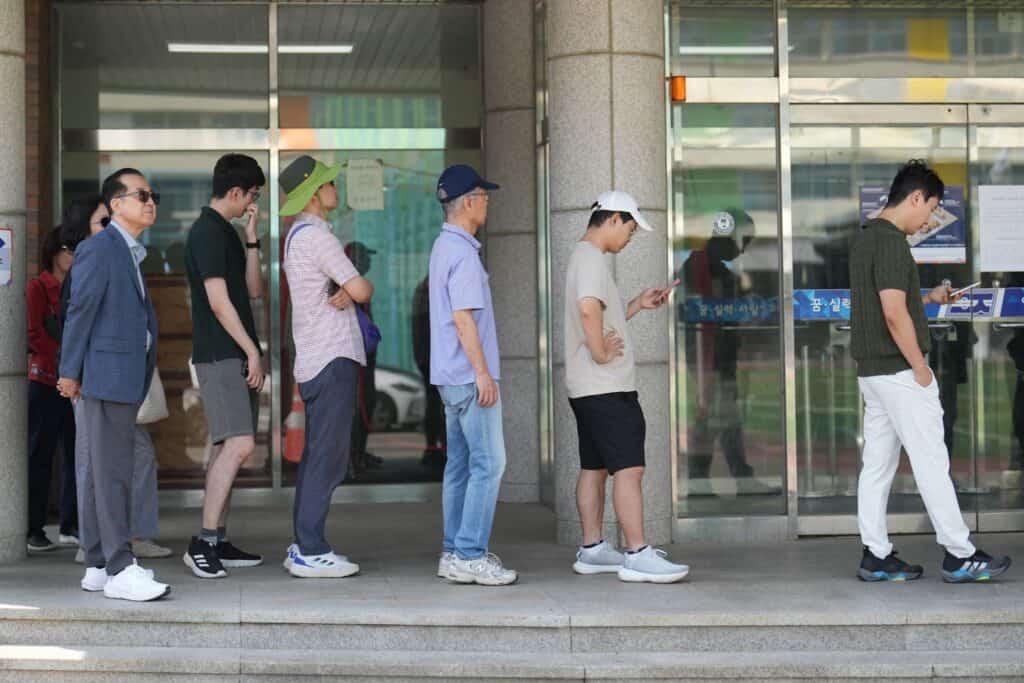
On June 3, South Korea held local elections for governors, mayors, and local council members, alongside several parliamentary by-elections. On election day, however, some polling stations ran out of ballots.
According to South Korea’s National Election Commission (NEC), ballot shortages occurred at 50 of the country’s roughly 14,300 polling stations. Voting was temporarily suspended at 22 locations, and some voters were unable to cast ballots after enduring long waits or failing to receive ballots before polls closed.
The incident triggered widespread criticism of election management. The chair of the NEC resigned to take responsibility, while President Lee Jae-myung ordered a thorough investigation and called for reforms to prevent similar problems in future elections.
The controversy continues to reverberate in South Korean society. Although authorities have described the incident as an administrative failure and stated that no evidence of ballot tampering or systematic election fraud has been found, some citizens and political groups argue that the disruptions compromised the fairness of the election and have called for a re-vote. Small-scale demonstrations demanding new elections have continued in Seoul and other cities.
Four Types of Narratives in Taiwan
Election controversies in neighboring South Korea are not new to Taiwanese audiences. Yet once these stories entered Taiwan’s information environment, they evolved beyond reports of administrative failures.
According to TFC’s monitoring, narratives circulating in Taiwan generally fell into four categories:
| Narrative Theme | Examples |
| Election fraud “evidence” | Ballots already stamped but without fold marksBallots allegedly printed on “shape-memory paper”Ballots found in trash binsBallot boxes reopened and stuffed with additional ballots |
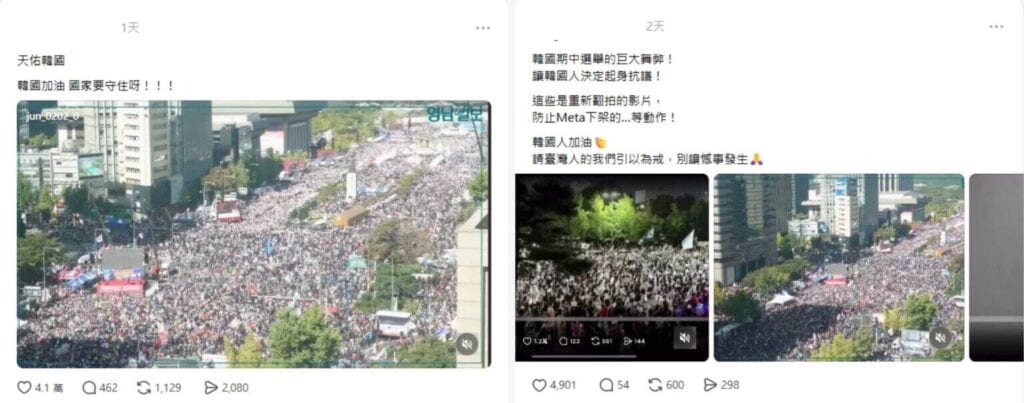
| Protests and social mobilization | Images claiming to show massive demonstrations against election fraud in Seoul’s Gwanghwamun areaAerial footage of crowds surrounding sports venues |
| Chinese interference and infiltration | Claims that turnout reached 130% because of Chinese votesChinese residents influencing electionsChinese journalists or police infiltrating South Korean institutions |
| Democratic failure and justification for martial law | Arguments that the controversy proves Chinese infiltration and therefore validates former President Yoon Suk Yeol’s declaration of martial law |
These narratives often reinforced one another. Alleged evidence of election fraud was linked to Chinese influence, which in turn was used to argue that extraordinary measures were necessary to protect democracy.
South Korea’s election dispute fuels Taiwan’s absentee voting anxiety
Many of the narratives circulating in Taiwan focused on Chinese election interference.
Beginning in the early hours of June 4, claims appeared across Taiwanese social media asserting that South Korea’s voter turnout had reached 130 percent. These posts (see below) were often accompanied by statements suggesting that overseas ethnic Chinese voters had artificially inflated turnout figures, that South Korea was becoming “the next Hong Kong,” or that the election demonstrated the dangers of pro-China policies.
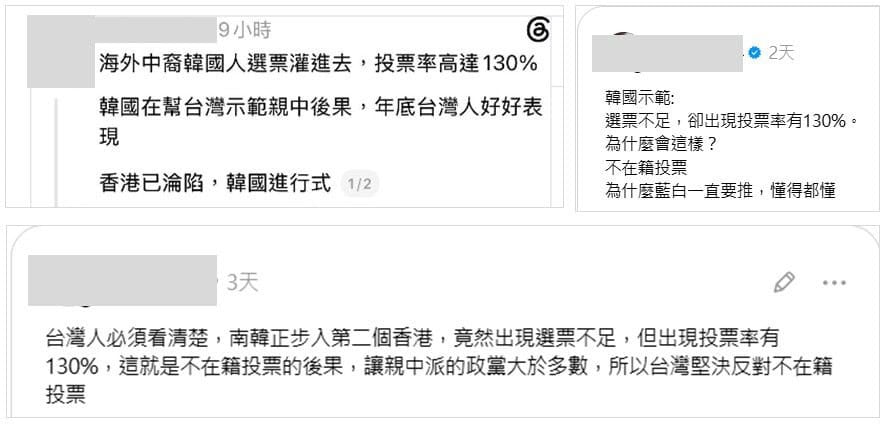
No evidence was provided to support these allegations.
According to official data released by South Korea’s NEC, nationwide voter turnout was 61 percent. The highest turnout among all provinces was recorded in Gangwon Province at 64.5 percent—far below the widely circulated figure of 130 percent.
The rumor appears to have originated from conspiracy theories already circulating within South Korea before the election. Because South Korea allows early voting across administrative districts, some small jurisdictions can temporarily record more ballots than registered residents during the counting process. However, these votes are ultimately allocated to larger electoral districts, ensuring that final turnout figures do not exceed the number of eligible voters. South Korean election authorities had already publicly explained this process.
Claims about Chinese residents influencing elections followed a similar pattern. According to a MyGoPen investigation, South Korean law grants local voting rights to foreign residents aged 18 or older who have held permanent residency for at least three years. South Korean broadcaster MBN reported in May 2026 that approximately 150,000 foreign nationals were eligible to vote in the local elections, with Chinese citizens representing the largest group.
Once these discussions reached Taiwan, they were reframed into narratives about Chinese vote manipulation and the risks of absentee voting. Some online commentators explicitly linked the South Korean controversy to Taiwan’s ongoing debate over potential absentee voting reforms.
“Chinese journalists disguised as police”: A familiar China threat narrative
Another widely shared claim alleged that South Korean police had been infiltrated by Chinese agents.
Several posts circulated photographs purportedly showing a Chinese journalist wearing a South Korean police uniform at a protest site. Others claimed that many South Korean police officers had Chinese names or that Chinese authorities had dispatched ethnic Korean officers to impersonate South Korean police.
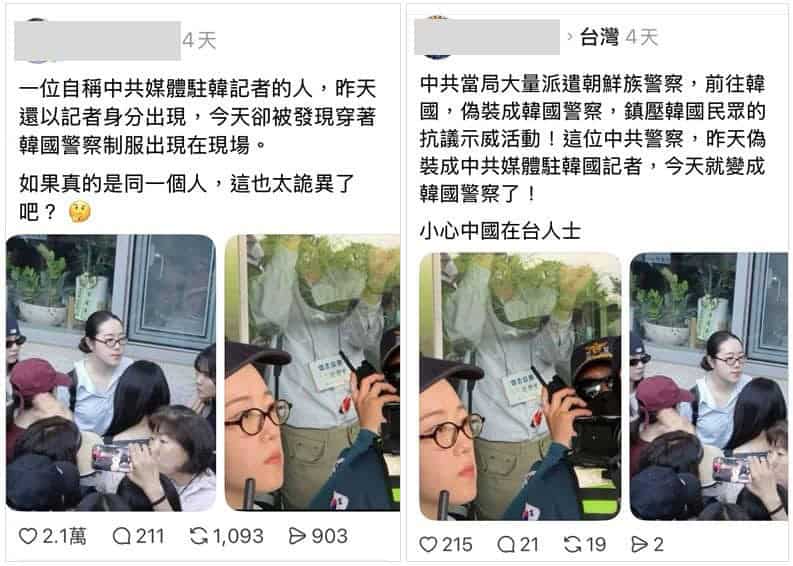
These claims were later debunked. TFC’s investigation found that the woman featured in the viral photograph was actually a JTBC reporter from South Korea, not a Chinese citizen. She was not impersonating a police officer. What appeared to be a police cap on her head was actually the cap of an officer standing next to her. The viral image had been cropped in a way that created a misleading visual illusion.
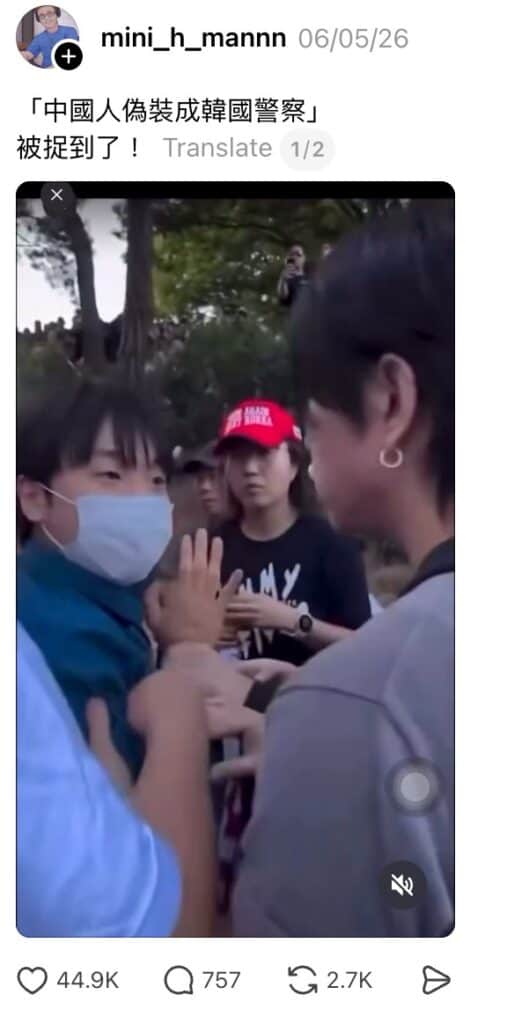
Another viral video claimed that a Chinese man disguised as a police officer had been exposed. MyGoPen found that the South Korean social media user who originally posted the video later deleted it and publicly acknowledged that the man shown was indeed a legitimate police officer.
By the time the correction appeared, however, the video had already spread widely within Taiwan. Many Taiwanese users who encountered the clip never saw the original clarification.
China interference conspiracies are also growing in South Korea
Notably, conspiracy theories about Chinese election interference are not unique to Taiwan.
On June 8, South Korea’s National Police Agency issued a public statement responding to online claims about “fake police officers” and “Chinese police.” After reviewing all reported cases, authorities concluded that every individual identified in the allegations was in fact a legitimate South Korean police officer.
South Korean broadcaster JTBC’s fact-checking team also recently debunked another China-related election conspiracy theory. Some politicians had alleged that Chinese nationals were transporting early voting ballot boxes and accused the government of surrendering South Korea’s sovereignty to China.
JTBC interviewed the driver at the center of the allegations and found that he was a naturalized South Korean citizen of Chinese descent. Throughout the transport process, election officials, observers, and police officers were present, making it impossible for him to access or manipulate the ballot boxes independently.
Localizing foreign conspiracies
Many of these conspiracy theories originated within South Korea’s own political environment. Yet after crossing linguistic and national boundaries, they were adapted to fit Taiwan’s existing concerns about Chinese interference, absentee voting, and national security.
The result was not simply the spread of misinformation about a neighboring country’s election. Rather, it became a process of localization: foreign controversies were reinterpreted through Taiwan’s political anxieties, producing new narratives that resonated with local audiences.
In doing so, South Korea’s election dispute became more than a South Korean story. It became a mirror reflecting Taiwan’s own debates about democracy, security, and the role of China in shaping public perceptions of both.
*Editor’s Note: This article was originally published in Chinese and translated with the help of AI and has been carefully reviewed and edited for an international audience.