


*Editor’s Note: This article was originally published in Chinese and translated with the help of AI and has been carefully reviewed and edited for an international audience.
By Wei-Ting Chen
“That’s not me, and I’ve never recommended any of those products.”
In recent years, an increasing number of Taiwan’s most respected physicians have found themselves repeatedly issuing the same public clarification: the doctors appearing in viral online videos are not actually them.
Among those targeted are Shan-Chwen Chang, vice president of National Taiwan University; Wei-Ming Chen, superintendent of Taipei Veterans General Hospital; Jin-Shing Chen, chief of surgery at National Taiwan University Hospital; and Da-Wen Lu, a leading ophthalmologist at Tri-Service General Hospital. Their names, photographs, videos, and even voices have been appropriated by scammers and transformed into convincing AI-generated endorsements for fraudulent medical products.
For many of these physicians, combating deepfake advertisements has become an exhausting and seemingly endless battle.
Medical impersonation itself is not new. For years, scammers have stolen doctors’ names and photographs, created fake Facebook pages, and built fraudulent shopping websites to lure patients into purchasing bogus treatments.
But generative AI has dramatically raised the stakes.
Using publicly available television interviews, educational videos, speeches, and radio recordings, fraudsters can now train AI models to replicate a physician’s face and voice. Deepfake technology enables them to fabricate entirely new videos in which trusted doctors appear to promote products they have never seen—let alone endorsed.
The result is content so convincing that many viewers struggle to recognize the deception.
“It looks exactly like the doctor,” many victims think. “How could it possibly be fake?”

Taiwanese doctors repeatedly targeted as scam products trace back to China
Dr. Da-Wen Lu, one of Taiwan’s leading glaucoma specialists, has been impersonated by scammers for years.
As early as 2022, his identity was used to market eye drops falsely claiming to cure virtually every eye disease. In March this year, scammers once again hijacked his image, this time generating multiple AI-edited versions of him to promote dietary supplements that supposedly protect cardiovascular health or treat dry eye disease.
Many patients, believing the advertisements to be genuine, later brought these products into Lu’s clinic to ask whether they should take them.
“It never ends,” Lu said.
“We’ve publicly clarified the scams again and again. The hospital has held press conferences, and we’ve reported the cases to the police. But despite all of that, patients continue to fall victim.”
Many of the products brought into his clinic were manufactured in China, with labels indicating factories in provinces such as Guizhou and Guangdong. According to Lu, the same product often appears across numerous fake shopping websites, each accompanied by different deepfake videos—evidence of a highly organized operation supported by multiple production lines.
An investigation by Taiwan FactCheck Center reached a similar conclusion.
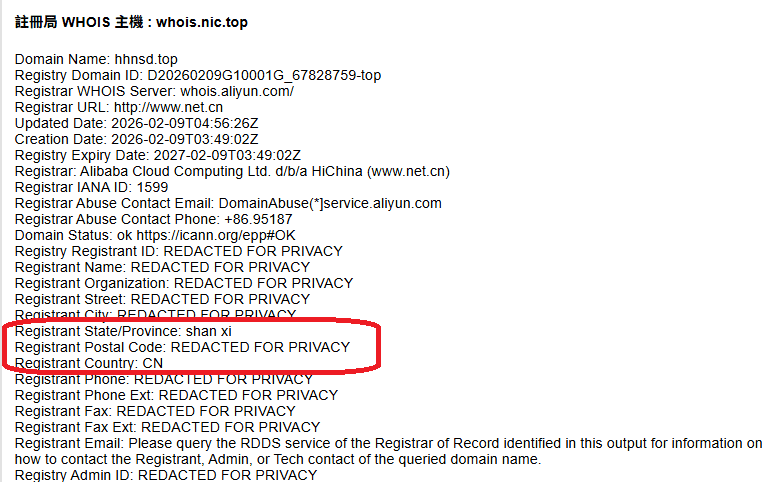
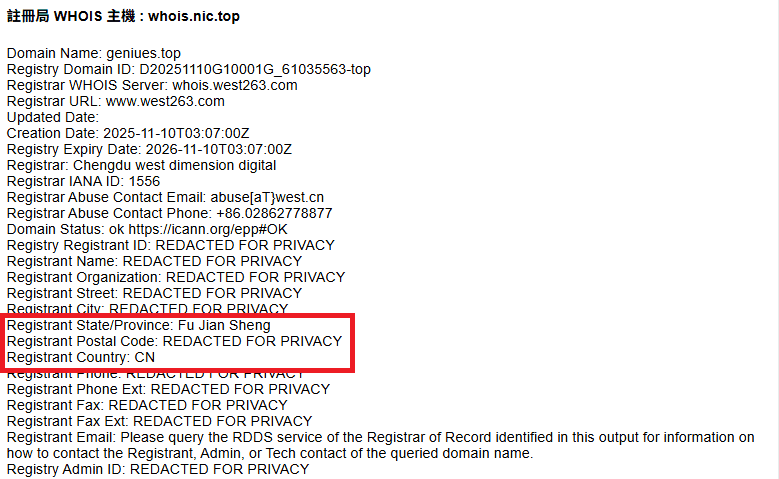
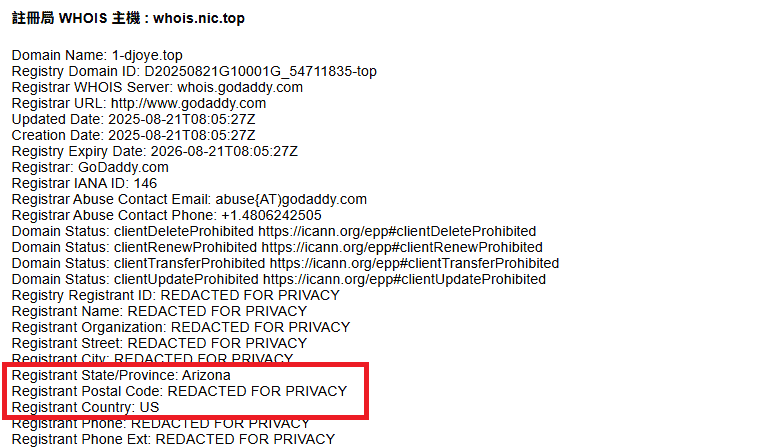
Using domain registration analysis tools, reporters examined three separate shopping websites selling the same products under Lu’s identity. All three domains had been registered for only one year—a common characteristic of disposable scam websites designed to disappear quickly.
Two of the websites were registered in Shanxi and Fujian provinces in China, while another listed Arizona, United States, as its registration location. All three employed privacy protection services that concealed the identities of their actual operators.
Cross-border scams leave doctors with few legal options
The fact that most of these fraudulent websites operate overseas has made enforcement especially difficult.
The operators remain anonymous, placing them largely beyond the reach of Taiwan’s legal system. For many doctors, there is little they can do beyond warning the public and trying to protect themselves.
“The situation has become almost hopeless,” said Dr. Jin-Shing Chen, chief of surgery at National Taiwan University Hospital.
Chen has also become a frequent target of medical scams. His identity has been used to promote a wide range of products claiming to clear phlegm, improve lung function, and treat respiratory diseases. By his own estimate, more than a dozen fraudulent campaigns have exploited his name.
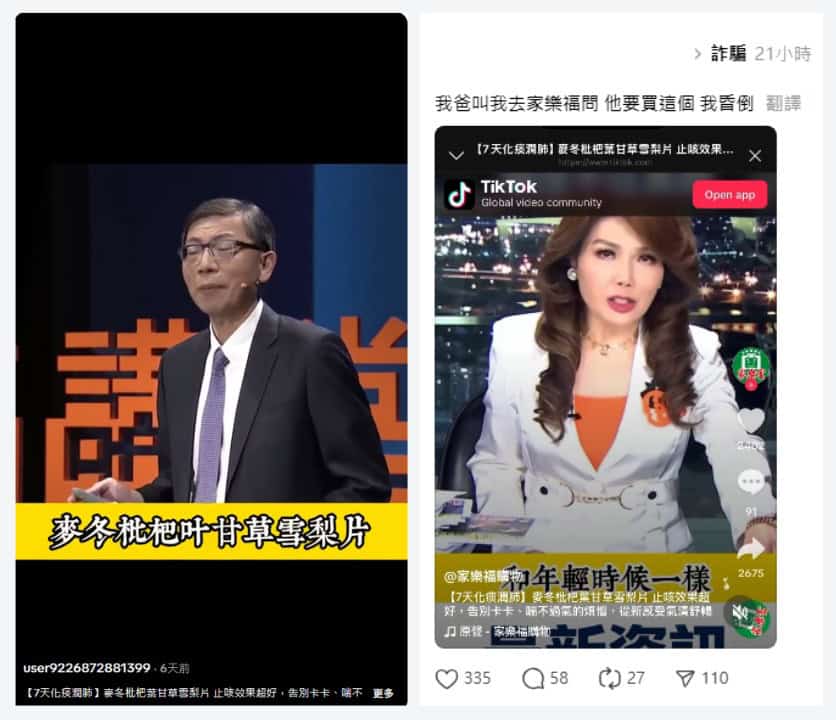
One widely circulated deepfake video features an AI-generated version of Chen enthusiastically promoting herbal lozenges that supposedly reverse pulmonary fibrosis. In the fabricated endorsement, “Chen” even claims he is personally contributing NT$100,000 to subsidize the product so that more patients suffering from lung disease can afford it.
“It’s impossible to stop,” Chen said.
“The people behind these scams are overseas, so they can’t be caught. As soon as one video is taken down, another appears. It feels like a never-ending game of whack-a-mole.”
The consequences extend beyond financial fraud. Many patients schedule appointments specifically to ask Chen where they can buy the products they saw online.
Unable to prevent the scams, Chen has resorted to posting a large notice outside his clinic that reads:
“I do not sell medicine.”
“That’s about the only thing I can do,” he said.
Fighting scams one patient at a Time
Another frequent target is Dr. Wei-Ming Chen, superintendent of Taipei Veterans General Hospital and one of Taiwan’s leading orthopedic surgeons.
Across Taiwanese social media platforms, AI-generated versions of Chen have appeared promoting everything from pain-relief creams and anti-itch medications to nasal sprays and even supplements claiming to treat kidney disorders.
Chen remains visibly frustrated.
“In my daily practice, I always tell patients not to waste money on unnecessary products,” he said. “I encourage them to use medications covered by Taiwan’s National Health Insurance.”
Yet many patients are persuaded by the fake advertisements. Some spend considerable amounts of money buying ineffective products online before eventually making the often lengthy effort to secure an appointment at his clinic, hoping to confirm whether the advertisements were genuine.
“What pains me most,” Chen said, “is knowing that people who are already suffering from illness end up being exploited once again by scammers.”
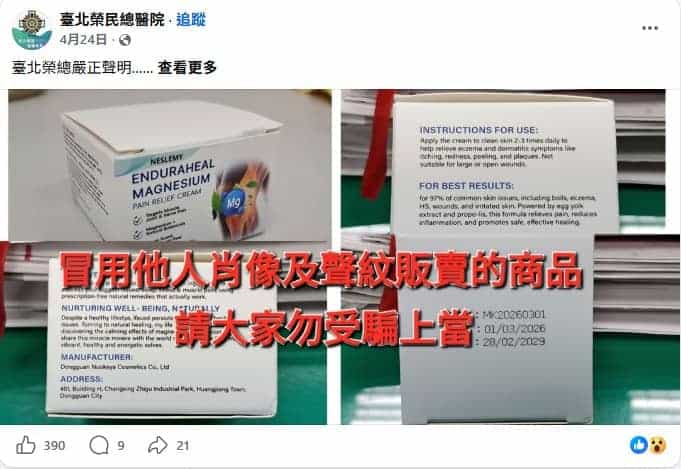
Whenever Chen discovers another scam using his identity, he reports it to the police. But he knows the limitations all too well.
Many of the websites appear to originate outside Taiwan—some with IP addresses traced to mainland China—making prosecution extraordinarily difficult.
In response, Taipei Veterans General Hospital has developed its own internal procedures for handling reports of medical scams.
Staff answering the hospital’s main phone line are trained to deliver a simple, consistent message whenever members of the public call about suspicious advertisements:
“Doctors at Taipei Veterans General Hospital do not sell medicine online.”
Chen has also made public education a central part of his response. He encourages anyone who has been deceived to preserve receipts, screenshots, and other evidence before reporting the case to investigators.
“The more evidence people provide,” he said, “the greater the chance that law enforcement will eventually be able to identify those responsible.”
AI medical scams threaten more than people’s wallets
According to the physicians interviewed by Taiwan FactCheck Center, the damage caused by AI-powered medical scams extends far beyond financial loss.
Dr. Da-Wen Lu and Dr. Jin-Shing Chen both noted that many of the products patients bring into their clinics appear relatively harmless at first glance. Some eye drops may contain little more than saline solution, while pills marketed as remedies for lung disease are often little more than starch mixed with flavorings.
But that does not make them safe.
Most of the products are labeled as having been manufactured in China, yet their production facilities are unknown, ingredient lists are incomplete or unclear, and there is no reliable way to verify what consumers are actually ingesting—or what long-term health risks these substances may pose.
Even more worrying, Chen said, are patients who delay legitimate medical treatment after believing the promises made in fraudulent advertisements.
Some cancer patients and people living with chronic illnesses are persuaded that inexpensive products sold online can spare them the hardship of conventional treatment.
Instead, they fall into a scam.
“By the time they realize they’ve been deceived,” Chen said, “they may already have lost precious time that could have been spent receiving proper treatment.”
When trust is manipulated
For Dr. Wei-Ming Chen, perhaps the greatest damage is one that cannot be measured in money or even health outcomes.
“The most harmful thing about these scams,” he said, “is that, one video at a time, they undermine patients’ trust in doctors.”
Deepfake technology allows scammers to fabricate physicians delivering false medical advice with remarkable realism. Many viewers naturally assume the videos are authentic.
Instead of recognizing that the doctors themselves are victims, people may conclude that the medical profession has become unreliable—or even that doctors themselves are spreading misinformation.
“People start wondering, ‘Why are doctors saying things like this?’ or ‘Has the medical profession become so chaotic?'” Chen said.
“In reality, physicians are among the victims.”

A template-driven network of AI “doctors” flourishes on YouTube
Beyond impersonating real physicians, Taiwan FactCheck Center has observed another rapidly growing phenomenon: an expanding ecosystem of AI-generated “doctor” videos on YouTube.
Beginning in the second half of 2025, large numbers of health-related YouTube channels emerged that appeared remarkably similar. Although presented as educational medical content, the videos shared a common formula.
Their titles were highly sensational, often promising to reveal “hidden truths” or overturn conventional medical wisdom. Many cited individual patient stories or referenced supposedly authoritative medical research. Nearly all featured presenters dressed in white lab coats, speaking with the confidence and authority expected of medical professionals.
A closer comparison, however, revealed striking similarities in both scriptwriting and production style, suggesting that many of the videos had been generated using AI.
The misinformation they promoted ranged from fabricated medical breakthroughs—such as claims that National Taiwan University Hospital or Taipei Veterans General Hospital had developed probiotic therapies capable of curing diabetes—to misleading health advice, including assertions that eating green bananas could treat frequent nighttime urination.
Many viewers accepted these claims as genuine, raising growing concerns about their impact on public health.
Research reveals highly coordinated patterns
In June, Taiwan FactCheck Center and Taiwan’s National Institute of Cyber Security (NICS) jointly analyzed 74 YouTube channels that regularly published AI-generated “doctor” videos.
The researchers found that the overwhelming majority followed nearly identical production patterns.
Video thumbnails almost always featured doctors in white coats, accompanied by emotionally charged headlines such as:
“Everyone over 60 must watch this.”
“99% of people don’t know this.”
“Doctors finally reveal the truth.”
The videos themselves focused on a relatively narrow range of topics, including dietary warnings, chronic diseases, nutritional supplements, and advice for healthy aging.
Rather than reflecting the diversity typically seen among independent content creators, the channels appeared to rely on standardized production templates.
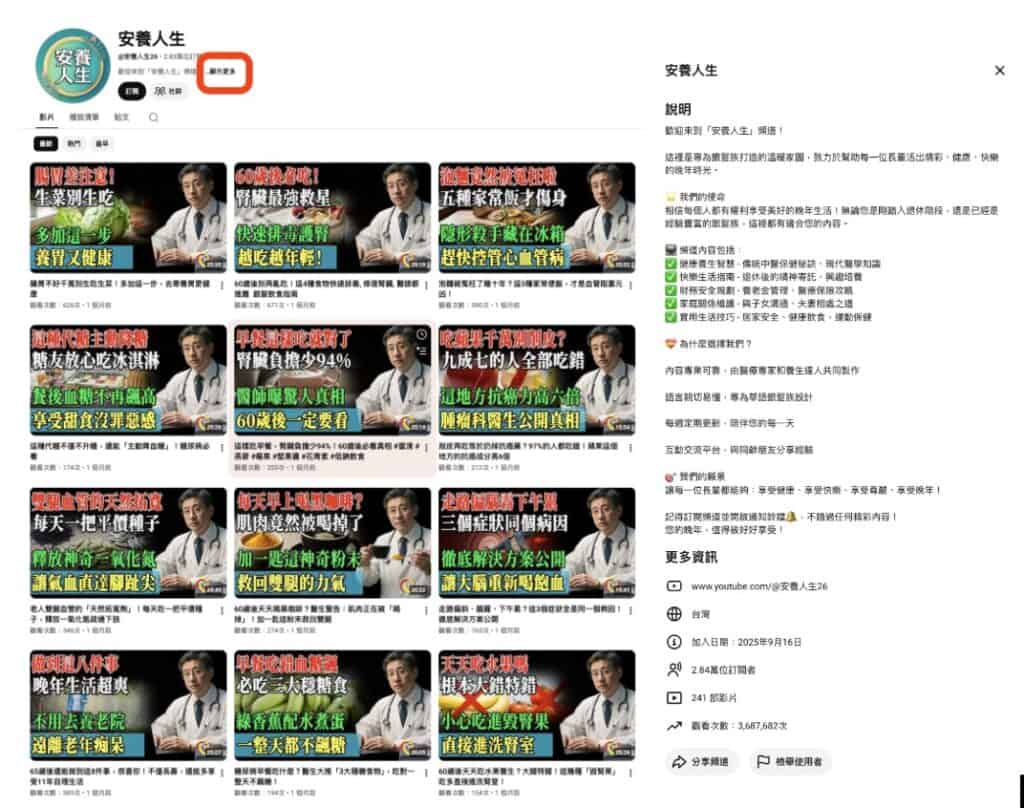
One representative example is the YouTube channel “Peaceful Retirement Life” (安養人生).
Nearly every video follows the same visual design, layout, typography, and color scheme. Clicking the “Show more” section beneath each video reveals another unusual feature: there are no links to social media accounts, official websites, contact information, or any other identifying details that legitimate creators typically provide.
Even the channel names appear AI-generated
The similarities extended beyond the videos themselves.
Researchers found that nearly two-thirds of the 74 channels had names built from the same limited pool of words, including combinations of terms such as “health,” “wellness,” “retirement,” and “healthy aging.”
Rather than reflecting distinct brands or creators, many names appeared to have been generated by randomly combining predefined keywords.
Such naming patterns are rarely seen among ordinary YouTube creators and suggest the channels may have been produced in batches rather than individually.
Another curious clue lay in the channels’ permanent YouTube handles.
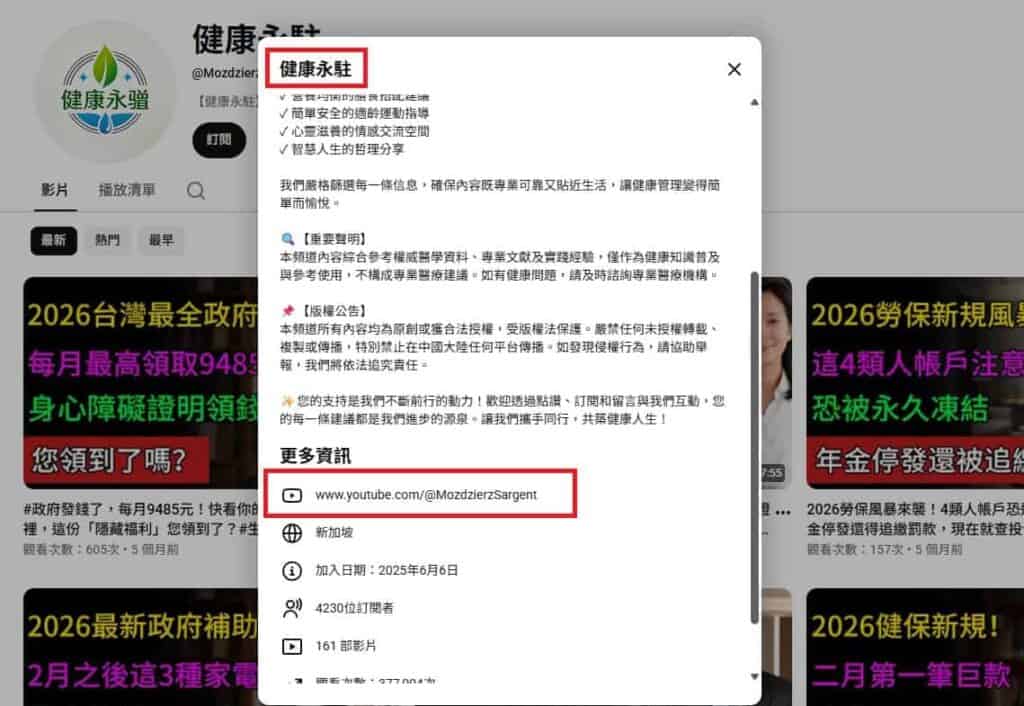
Several channels displayed Chinese-language names while their immutable channel IDs still contained Vietnamese, Polish, Portuguese, or other foreign-language words.
Researchers believe this may indicate that the channels were originally created in bulk for audiences speaking other languages before later being renamed for Chinese-speaking viewers. Because YouTube handles cannot always be modified after creation, traces of their original identities remained visible.
A sudden shift toward politics
Researchers also observed another unusual pattern.
Among the 74 channels analyzed, 15 abruptly abandoned health-related content altogether.
Instead of gradually expanding into new subjects—as many legitimate creators do—they suddenly began publishing videos about government subsidies, welfare policies, financial crises, wars, or geopolitical conflicts.
According to NICS researchers, these shifts were far from random.
The new topics consistently centered on subjects known to generate high engagement, stronger emotional reactions, or greater advertising revenue.
Equally striking was the way the transitions occurred.
Rather than evolving over time, the channels switched content overnight. One day they uploaded health advice; the next, they had become political commentary channels, with no transitional period whatsoever.
Such abrupt transformations differ markedly from the gradual changes typically seen when genuine creators broaden or redefine their content.
Taiwan seeks new tools to combat AI-driven medical misinformation
The rapid rise of generative AI has not only accelerated the spread of misinformation—it has also made medical scams far more convincing.
After Taiwan FactCheck Center exposed the AI-generated “Dr. Chen Chih-Ming” case in November 2025, Taiwan’s Ministry of Health and Welfare pledged to review existing regulations and explore mechanisms requiring online medical content to disclose the identity of physicians featured in videos.
The issue has since become part of a broader discussion about how governments should respond to AI-generated health misinformation.
Speaking at a symposium hosted by Taipei Medical University in March, Liu Yueh-Ping, Director-General of the Department of Medical Affairs at the Ministry of Health and Welfare, acknowledged that Taiwan’s current Medical Care Act was primarily designed to regulate medical advertising and prevent misleading promotional claims.
Today’s information environment, however, presents a fundamentally different challenge.
Social media platforms, influencer marketing, cross-border operators, and AI-generated content have together created regulatory gray areas that existing laws were never designed to address.
“Traditional enforcement alone is no longer sufficient,” Liu said. “We need to move beyond simply blocking harmful content and toward a broader governance approach.”
According to Liu, the government is considering a range of measures, including updating relevant regulations, clarifying the responsibilities of online platforms and AI service providers, introducing warning labels indicating that content does not constitute medical advice or diagnosis, and developing more effective reporting and takedown mechanisms for harmful health misinformation.
She also emphasized that regulation alone cannot solve the problem.
Future efforts, she said, will require closer collaboration between government agencies, healthcare professionals, fact-checking organizations, and digital platforms to strengthen public health literacy, improve doctor-patient communication, and build a more trustworthy online medical information ecosystem.
(Editor: Hui-An Ho)