

By Hui-An Ho and Wei-Ting Chen
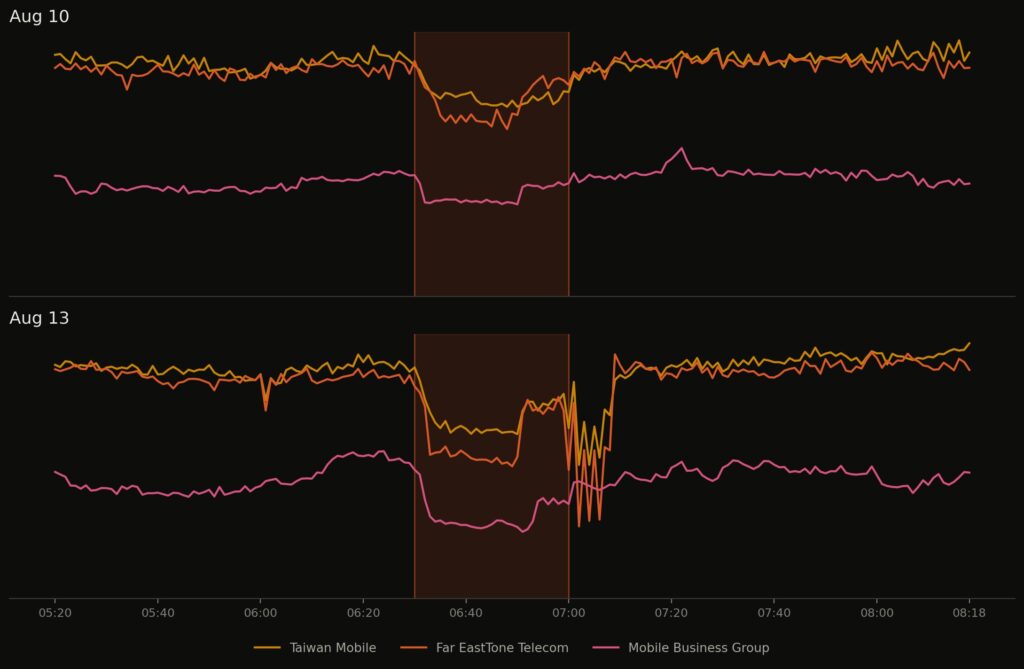
Taiwan’s 2026 Urban Resilience (Air Defense) Exercise included a mobile network slowdown drill for the first time. On August 10 and 13, people in 14 cities and counties within the exercise zones experienced sharply reduced mobile data speeds for 30 minutes, a move that sparked lively public debate in Taiwan.
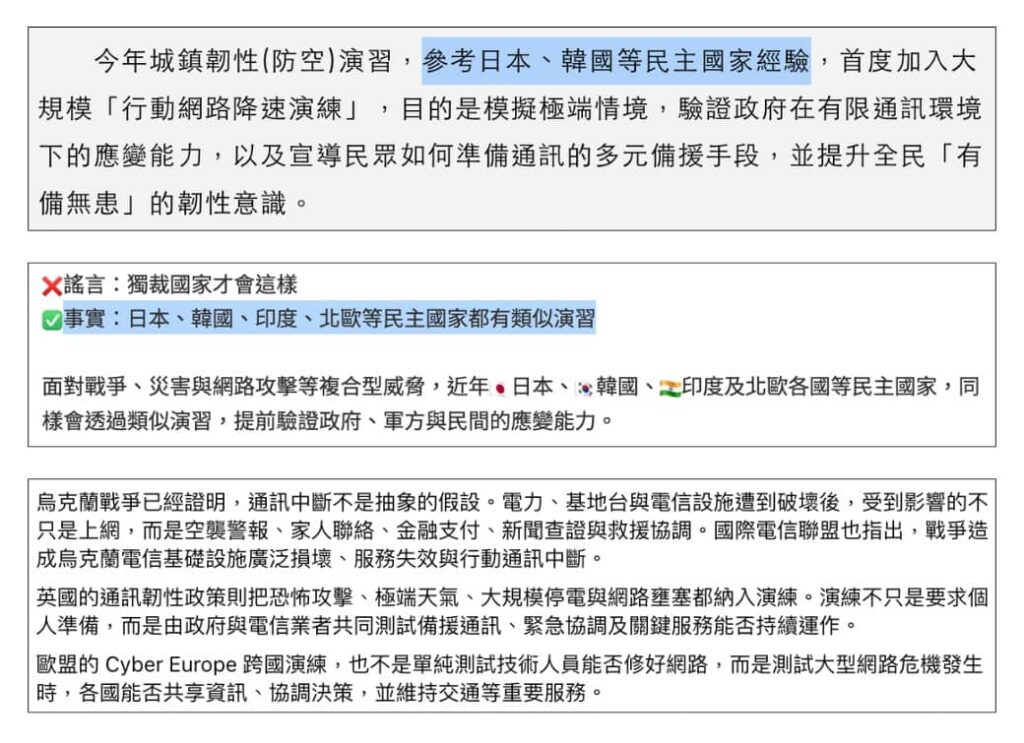
The government and supporters of the exercise said Taiwan was drawing on the experience of other democracies and was not an outlier. Critics, however, argued that other countries generally rely on simulations rather than deliberately disrupting services used by the public, and questioned whether Taiwan’s approach unnecessarily interfered with everyday life.
Based on interviews and research by the Taiwan FactCheck Center, countries including South Korea and Japan do conduct exercises involving communications failures, but these are typically carried out through simulations designed to test the emergency response capabilities of governments and telecom operators. They do not intentionally slow down mobile networks used by the general public.
In other cases, emergency communications measures have been activated after real-world outages or disasters—but those were responses to actual emergencies, not drills. Based on the information available to TFC, Taiwan’s decision to deliberately slow public mobile networks during an exercise may have been unprecedented internationally.
At the same time, Access Now, an international digital rights organization that tracks internet shutdowns worldwide, said Taiwan’s exercise did not meet its definition of an “internet shutdown.” The organization pointed to the drill’s short duration, its broader civil-defense context, and the government’s relatively high level of advance transparency and preparation. Still, Access Now stressed that deliberately degrading network quality would inevitably affect everyday life and that the necessity and actual impact of such a broad intervention should be carefully assessed.
Even so, several experts who closely follow Taiwan’s communications security said the lack of foreign precedent did not necessarily mean the exercise lacked value. Some problems are difficult to uncover through tabletop exercises or laboratory simulations alone: how millions of users respond when a network slows, which services fail, whether cybersecurity protections continue to function under severe bandwidth constraints, and whether backup systems across different sectors are adequate.
Taiwan’s geopolitical environment and security risks are also unusual, making direct comparisons with other countries difficult.
So how should we understand Taiwan’s first-of-its-kind communications exercise? What did the 30-minute slowdown reveal that conventional simulations might not—and what does the experiment tell us about Taiwan’s broader approach to communications resilience under extreme conditions?
Key Questions
How do South Korea and Japan exercise for communications disruptions? Has any country intentionally slowed down mobile networks used by the general public during an exercise?
Compared with tabletop or simulated exercises, what can a live test on a real public network reveal that other methods cannot?
Taiwan Added Mobile Network Slowdowns to a National Exercise for the First Time
According to Taiwan’s Ministry of National Defense, the mobile network slowdown exercise took place from 2:30 p.m. to 3:00 p.m. on August 10 in central Taiwan and August 13 in northern Taiwan. Mobile data speeds were sharply reduced for 30 minutes across 14 cities and counties in the exercise zones.
The government said the exercise was intended to test whether telecom operators and relevant agencies could coordinate emergency resource allocation, and whether emergency hotlines and basic channels for essential communications would remain functional. Authorities also tested backup systems including fixed-line networks, radio communications, and paper-based procedures.
For the public, the government hoped the temporary inconvenience would simulate a scenario in which communications resources became severely constrained during war, a major disaster, or a cyberattack, encouraging people to think in advance about alternative ways to stay connected.
Taiwan had conducted many disaster and air-defense drills in the past, but this was the first time authorities deliberately reduced mobile data speeds for ordinary users.
Mobile phones are now deeply embedded in everyday life—from LINE and social media to online banking, mobile payments, ride-hailing, food delivery, and cloud services. For many people, experiencing a deliberately slowed network was unfamiliar.
South Korea: Exercises Are Simulated to Avoid Disrupting the Public
So how do other countries actually conduct similar exercises?
Based on TFC’s interviews and research, many countries and regions conduct communications-related resilience exercises, but most rely on tabletop scenarios, server-side testing, simulators, or closed environments. They do not deliberately interfere with public mobile communications.
South Korea and Japan were among the countries most frequently cited in Taiwan’s debate.
With assistance from South Korean media including Asia Business Daily, TFC contacted South Korea’s Ministry of the Interior and Safety (MOIS) and Ministry of Science and ICT (MSIT). Both ministries said South Korea had never conducted an exercise that intentionally shut down, throttled, or restricted mobile data networks used by the general public.
Instead, national exercises use simulations, including map-based tabletop scenarios, virtual environments, or server-side testing, specifically to ensure that normal public services remain unaffected.
“There are many ways to conduct wartime emergency preparedness exercises, but deliberately shutting down a live communications network during a drill is effectively impossible,” an official from MOIS’s emergency preparedness training division told TFC. “It would immediately disrupt people’s daily lives and national industry.”
The division is responsible for South Korea’s major civil-military defense exercise, the Ulchi Exercise.
South Korea has experienced large-scale telecommunications disruptions caused by real accidents, including the 2018 KT Ahyeon fire and the 2022 Kakao data center fire. After those incidents, the government required telecom operators to strengthen backup infrastructure, including a disaster roaming system that allows users to connect automatically to another carrier if their own network goes down, as well as emergency public Wi-Fi systems.
But when these systems are tested, South Korea does not cut off the public’s network access. Instead, authorities assume that a network failure has occurred in a specific area and have telecom operators rehearse deploying mobile base station vehicles or activating emergency Wi-Fi. Ordinary 4G and 5G services remain operational.
South Korean interviewees also noted that the law strongly protects the public’s right to telecommunications services. They said neither the government nor private telecom companies could restrict communications simply for the purpose of an exercise.
Article 50 of South Korea’s Telecommunications Business Act prohibits operators from providing services in ways that harm users’ interests. A defense exercise is not considered a legitimate reason to infringe on those rights by cutting or restricting public mobile networks.
Japan: The Focus Is on Restoring Communications, Not Disrupting Them
Atheta Tong, a researcher based in Japan who specializes in submarine cable security and geopolitical risk and is affiliated with the University of Tokyo and the Institute of Strategic Risk Studies, said Japan has conducted many communications and disaster-response exercises. But to her knowledge, none has intentionally slowed or interrupted commercial mobile networks used by the public.
For example, Japan’s Ministry of Internal Affairs and Communications holds annual Emergency Communications Exercises alongside nationwide disaster drills. These exercises assume that telecom lines have failed and existing communications networks are unavailable. Participants then practice maintaining contact through alternatives such as private radio systems, amateur radio, and satellite phones.
Commercial networks themselves are not disrupted.
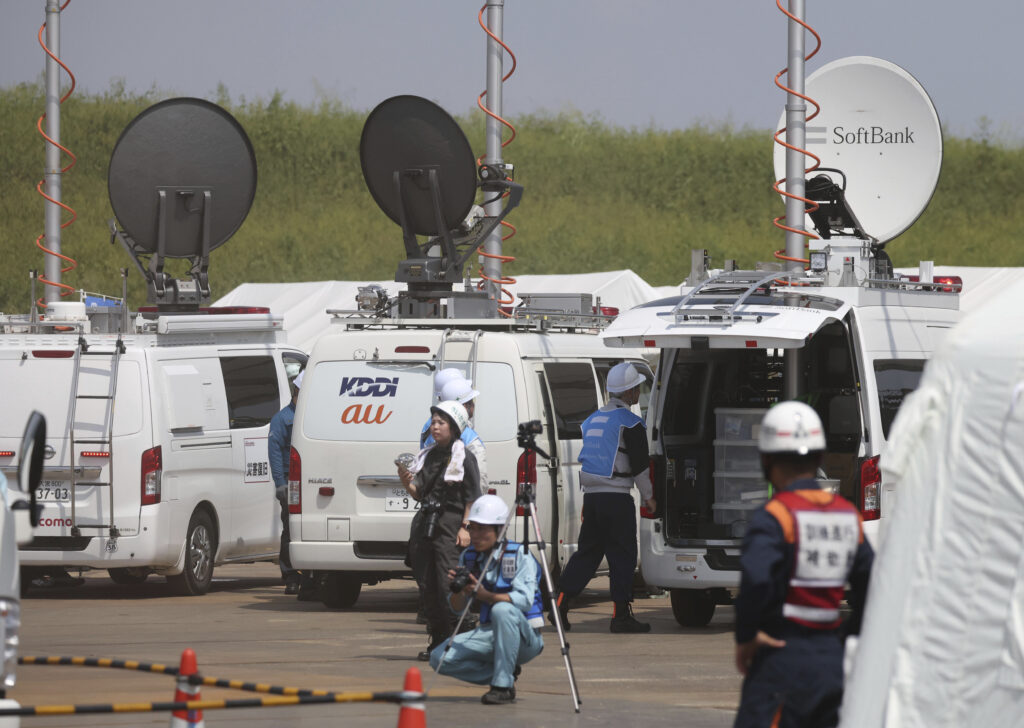
Similarly, annual disaster drills by major telecom companies such as NTT Docomo, KDDI, and SoftBank focus on how to repair damaged base stations and restore communications as quickly as possible. Measures include deploying mobile base station vehicles, Starlink satellite systems, drones, and other backup technologies.
In other words, Japan trains to restore a network after an assumed failure—the opposite direction from Taiwan’s exercise.
In December 2025, the Japanese government and Tokyo Metropolitan Government also held a large-scale critical infrastructure failure exercise based on a scenario involving a major blackout in the Tokyo metropolitan area, followed by water outages, communications failures, and transport disruptions. About 300 people participated, but the exercise was conducted as a tabletop simulation, and the government did not publicly disclose the detailed scenarios.
The Japan Fact-check Center also told TFC that it was unaware of any Japanese exercise that deliberately restricted public mobile data services. Japan does test backup systems for disasters, but those tests do not intentionally impair communications used by ordinary people.
Tong noted that after the 2011 Great East Japan Earthquake, Japanese telecom operators did impose traffic controls, but those measures mainly restricted voice calls while data services were less affected. More importantly, that was an emergency response to a real disaster—not an exercise.
Japan also launched its JAPAN roaming emergency support system in April this year, allowing telecom carriers to provide mutual support during disasters. Routine tests rely on simulators.
On April 22, a wildfire in Otsuchi, Iwate Prefecture disrupted Docomo services, prompting the first real activation of the emergency roaming system. Again, this was a response to an actual disaster rather than a drill.
Singapore: Simulating Digital Disruptions and Cyberattacks
Singapore was also cited in Taiwan’s public debate, but its exercises likewise rely on simulated scenarios and tabletop drills rather than deliberately slowing mobile networks used by the public.
The Singapore Trade Office in Taipei told TFC that since 2024, Singapore’s Ministry of Defence has held Exercise SG Ready around Total Defence Day each year to test and strengthen whole-of-society preparedness for real-world crises.
The exercise involves businesses, schools, community organizations, and other sectors, and covers a wide range of scenarios.
This February’s exercise included simulations of e-service disruptions and digital connectivity disruptions. Participating organizations placed non-essential applications into maintenance mode for one hour, while businesses and community groups took part in tabletop exercises examining how to respond to prolonged power and internet outages.
In the cybersecurity field, Singapore’s Cyber Security Agency holds Exercise Cyber Star every two years to strengthen preparedness across critical sectors.
The 2025 edition was the largest and most intensive to date, lasting 11 days and involving nearly 500 participants. Participants included government regulators, the Singapore Armed Forces’ Digital and Intelligence Service, and critical information infrastructure operators across 11 sectors.
Comparing Communications Resilience Exercises Abroad with Taiwan’s Approach
| Country / Case | Exercise Method | Key Difference from Taiwan |
| South Korea | Exercises such as Ulchi rely on tabletop scenarios or server-side simulations. Disaster roaming is demonstrated in controlled environments. | Authorities simulate base station failures and cross-carrier backup systems without subjecting ordinary users to large-scale throttling. Real outages have resulted from fires or system failures, not drills. |
| Japan | Uses tabletop exercises and simulators to assume network failures, then rehearses radio, satellite phone, emergency roaming, and base station recovery. | Japan assumes the network has already failed and tests backup and recovery systems rather than deliberately disrupting commercial networks. |
| Singapore – Exercise SG Ready | Simulates restricted digital connectivity. Some non-essential apps and websites are placed in maintenance mode for an hour, alongside tabletop exercises and backup communications testing. | Some designated services are temporarily unavailable, but there is no region-wide throttling of the public telecommunications network. |
| India – Operation Abhyaas | Exercises warning systems, evacuations, blackout measures, and civil defense responses. | Available information does not confirm that public mobile networks were throttled. Other internet shutdowns in India have generally involved social control rather than exercises. |
| Sweden – Telö 24 | About 190 experts participated in a field exercise simulating damage to critical infrastructure and testing equipment repair, resource deployment, and coordination. | Although described as a field exercise, the infrastructure failures themselves were simulated. The focus was on operators, personnel, and procedures—not ordinary users’ connectivity. |
| Germany and the United States – public alert tests | Test whether emergency alerts can reach mobile phones, radio, and television. | These exercises test the delivery of alerts rather than simulating bandwidth shortages. |
Sources: Athena Tong and Taiwan FactCheck Center research.
Access Now: Taiwan’s Drill Did Not Meet the Definition of an “Internet Shutdown”
Although TFC found no international precedent for this type of mobile network slowdown exercise, Access Now, an international nonprofit focused on digital rights and global internet shutdowns, said Taiwan’s drill did not meet its definition of an “internet shutdown.”
Access Now launched the global #KeepItOn campaign in 2016 to oppose government-imposed internet shutdowns and restrictions used to suppress freedom of expression and dissent. It regularly publishes research documenting shutdowns worldwide.
The organization defines an internet shutdown as:
“An intentional disruption of internet or electronic communications, rendering them inaccessible or effectively unusable, for a specific population or within a location, often to exert control over the flow of information.”
Access Now only tracks incidents lasting at least one hour.
Zach Rosson, Global Data and Research Lead for #KeepItOn, told TFC that the organization generally monitors and documents deliberate efforts to cut off information flows during key events such as elections, protests, and conflicts.
Governments may cite national security, public safety, or infrastructure failures as justification for shutting down the internet, he said, while the actual purpose may be to control the public. In many cases, governments do not even acknowledge that shutdowns occurred, and the measures often fail to meet international human rights standards of legality, necessity, and proportionality.
Access Now has, however, documented cases in which governments briefly cut, slowed, or blocked internet services under the guise of “tests” or exercises in preparation for larger shutdowns.
Examples include Belarus ahead of its 2025 election, Russia testing its sovereign internet system’s ability to disconnect from the global internet, and Guinea cutting internet access and blocking social media during a 2020 referendum.
“Although we will not consider the upcoming exercises in Taiwan to be internet shutdowns using the definition above and will not include them in our Shutdown Tracker,” Rosson said.
He pointed to the exercise’s short duration, the broader context, and the Taiwanese government’s relatively high level of advance transparency and preparation aimed at minimizing harm.
Still, he emphasized that intentionally degrading network quality to this degree inevitably affects everyday life.
Whether such a comprehensive disruption was necessary—and what actual impact it had—should still be carefully assessed by local organizations and technical experts in Taiwan, he said.
If No Other Country Does This, Was Taiwan’s Drill Still Worthwhile?
Kenny Huang, chairman of the Taiwan Network Information Center (TWNIC) and a member of Taiwan’s Whole-of-Society Defense Resilience Committee, wrote on Facebook that Taiwan’s past exercises had rarely subjected communications resilience to a genuine stress test.
Communications networks are not an unlimited resource, he noted. By simulating an extreme situation in which bandwidth became severely constrained, the exercise provided a real-world stress test that conventional drills cannot.
Athena Tong made a similar point.
Many issues simply do not emerge in tabletop exercises, simulators, or laboratory testing, she said. These include how millions of real users behave when networks slow down, which services fail, how cybersecurity protections perform under low-bandwidth conditions, whether traffic-prioritization rules work as intended, and whether backup systems across different institutions are actually sufficient.
“If you don’t test these things in the real world, they simply won’t show up,” she said.
“Tabletop exercises assume that everyone follows the script. But in reality, when the network slows down, millions of people may refresh pages at the same time, switch apps, or repeatedly redial calls. You can only reproduce that effect at real-user scale. A volunteer test group cannot generate the same behavior.”
Traffic prioritization offers one example.
A rule designed to reserve bandwidth for certain services has to work consistently across Taiwan’s three telecom operators, tens of thousands of base stations, and different generations of mobile devices. That cannot simply be assumed—it has to be verified.
“Does VoLTE voice calling really remain available when bandwidth is constrained? Can people still reach 110 and 119? Will emergency cell-broadcast alerts still get through?” Tong asked. “You have to test it physically.”
“Only in a real environment can we see what Taiwan’s actual digital dependence looks like.”
Huang said the drill could also allow agencies and operators responsible for critical infrastructure—including healthcare and emergency rescue, financial settlement systems, and traffic signal control—to test how their systems actually performed under bandwidth constraints.
That could help determine the minimum bandwidth requirements for different sectors and reduce the risk of misallocating scarce resources or allowing critical nodes to fail.
Tong argued that what Taiwan was really testing was governance once bandwidth becomes a rationed resource.
If submarine cables were damaged, Taiwan might not lose connectivity altogether. Instead, the more likely challenge could be deciding who gets access to the limited bandwidth that remains—and who has the authority to make those decisions.
From that perspective, designing the exercise around slowdown rather than total shutdown may actually resemble one of Taiwan’s more realistic risks.
Tong also saw another value in the drill: turning the abstract possibility of losing communications into a 30-minute lived experience.
“Situations people have never experienced are the easiest to fill with fear-based narratives,” she said.
“A society that has already experienced what it feels like to lose mobile internet, even briefly, may be less likely to immediately assume that war has started when a real disruption occurs. People may also be less vulnerable to narratives such as ‘the government has collapsed’ or ‘surrender is the only way to stay safe.’”
But Tong cautioned that if the exercise stopped after a single 30-minute slowdown, its value would remain largely symbolic.
“What really matters is what comes next—the gaps we still haven’t addressed.”
Those gaps include scenarios involving Taiwan’s outlying islands and prolonged disruptions; real-world testing of low-Earth-orbit satellite and microwave backup systems; greater transparency about how limited bandwidth would be allocated; and the fact that Taiwan still does not have its own submarine cable repair vessel.
Editor’s Note: Jinyoung Jeon and Myunghwan Lee of South Korea’s Asia Business Daily contributed to this article.