By Hui-An Ho, Hui-Wen Tseng, Yun-Kai Hsu, and Wei-Ting Chen
On February 28, the United States and Israel launched a series of strikes against Iran. Iran soon retaliated, and the conflict has continued since. As is often the case with major global events, social media and news platforms were quickly flooded with information and visuals.
Alongside this surge of content, however, came a wave of misinformation. As the conflict unfolded, many rumors began to take on a distinctly local dimension in Taiwan. Among the most prominent themes were energy security and evacuation policies—issues that resonate strongly within Taiwan’s social and political context.
As of March 30, 31 days into the conflict, the Taiwan FactCheck Center (TFC) had published 20 fact-checks. The misinformation evolved over time—from miscaptioned war footage to entirely fabricated narratives. In Taiwan’s complex geopolitical environment, discussions about the war frequently intertwined with perceptions of U.S. military power and broader international dynamics.
You can find all related fact-checks in TFC’s dedicated coverage hub.
Shortly after the war broke out, discussions in Taiwan quickly turned to evacuation policies. Media reports and social media posts questioned whether the government had arranged evacuation flights or charter services, and the debate soon expanded into comparisons between Taiwan and China’s crisis response.
At the same time, Chinese state media actively promoted narratives claiming it had assisted Taiwanese citizens in returning home—many of these claims about China’s role did not fully reflect the actual situation and tended to exaggerate its involvement.
Meanwhile, the conflict also triggered renewed anxiety around energy security. As Qatar—one of Taiwan’s key suppliers of liquefied natural gas—was affected by the war, rumors began circulating online that Taiwan would soon face electricity shortages or even rolling blackouts. These claims, however, lacked supporting evidence.
According to a Reuters report citing an internal Taiwanese government memo, authorities were concerned that Beijing could use the conflict to amplify such narratives as part of broader “cognitive warfare,” including the use of AI-generated videos claiming Taiwan was facing a “devastating” energy crisis.
Overall, the misinformation observed during the conflict can be grouped into several recurring narrative types (see the table following). In this article, we focus in particular on two of the more distinctive cases: claims that “China helped Taiwanese citizens return home” and that “Taiwan would soon face power shortages.”
Summary of misinformation narratives in the Iran conflict
Table: Taiwan FactCheck Center
Case Study 1: Evacuation Narratives and Political Messaging
After the conflict escalated, Iranian attacks on U.S. military bases in the region led to partial airspace closures across multiple countries. Because the Middle East is a major transit hub, many Taiwanese travelers found themselves stranded.
According to Taiwan’s Ministry of Foreign Affairs, there were over 3,000 Taiwanese nationals in the Middle East as of March 1, most of them in Saudi Arabia (around 2,000), the United Arab Emirates (around 300), and Qatar (around 200).
On the same day, China’s embassy in Israel announced it could assist Chinese citizens—and Taiwanese citizens—in evacuating to safer areas. However, based on publicly available information, there is no evidence that any Taiwanese nationals or overseas Taiwanese participated in evacuation efforts organized by China.
Online discussions quickly emerged criticizing Taiwan’s government for not arranging evacuation flights or charter planes. These debates soon expanded into broader comparisons between Taiwan and China’s crisis response capabilities.
As in previous crises, familiar narratives resurfaced online, such as claims that “China protects Taiwanese abroad” or that “China is more capable in emergencies.” These narratives echo earlier misinformation, including claims during the 2018 Kansai Airport incident that Chinese authorities evacuated Taiwanese travelers—when in fact airport authorities had arranged transportation.
A misleading video circulated online claiming that China had evacuated 3125 people from Iran. In fact, the video combined unrelated footage from earlier events—such as evacuations during the Sudan conflict—with current war narratives.
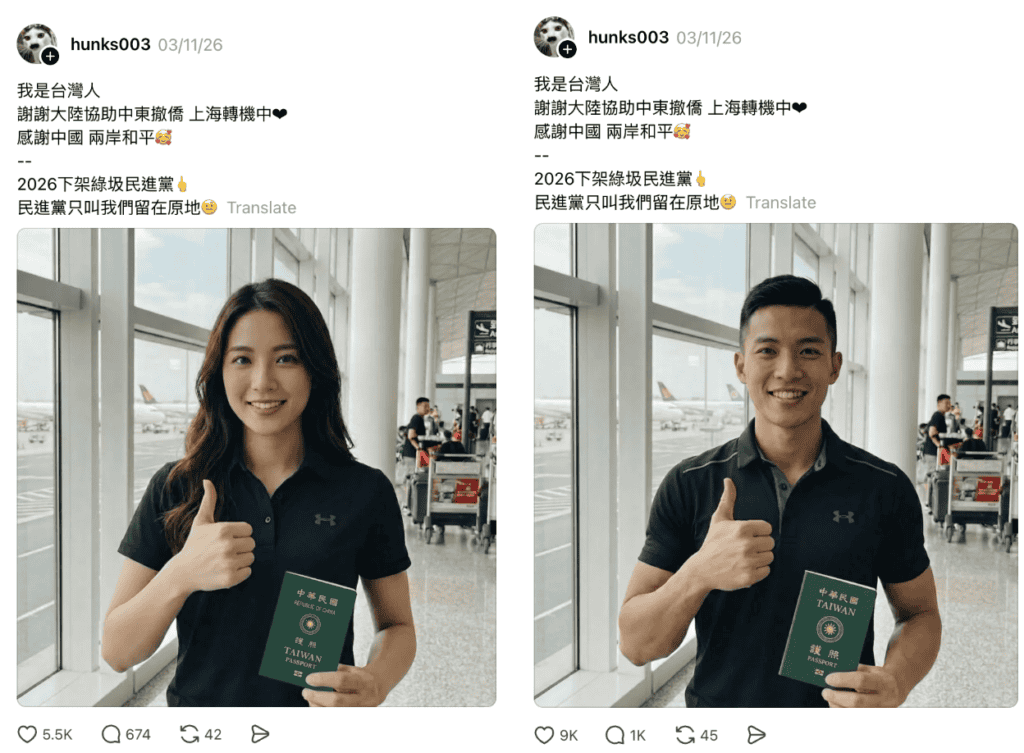
During this conflict, Chinesestatemedia widely reported that it had helped more than 70 Taiwanese travelers return home via Shanghai after flight disruptions. Taiwanese media also picked up the story.
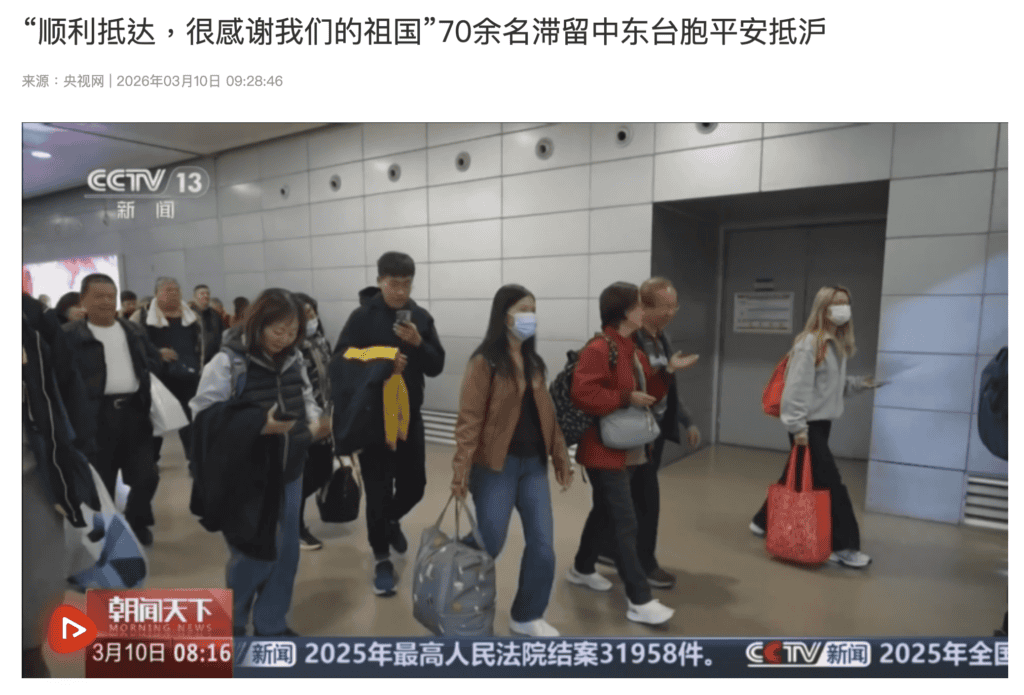
However, TFC’s verification found discrepancies between these reports and actual events. The travelers had been stranded in Turkey, not directly in conflict zones in the Middle East. Their travel agencies—not Chinese authorities—arranged alternative flights. In addition, online narratives exaggerated the situation, claiming that China had arranged charter flights or conducted large-scale evacuation operations.
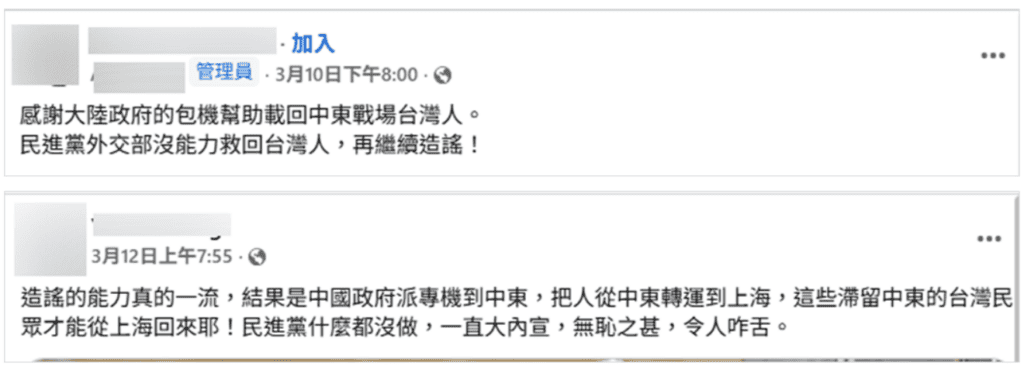
It is important to note that Chinese authorities did provide some assistance. However, their role was limited to helping 25 travelers who lacked the necessary documents by issuing temporary permits so they could transit through Shanghai. Compared with this, the narratives promoted by state media and widely circulated online significantly exaggerated the extent of China’s involvement.
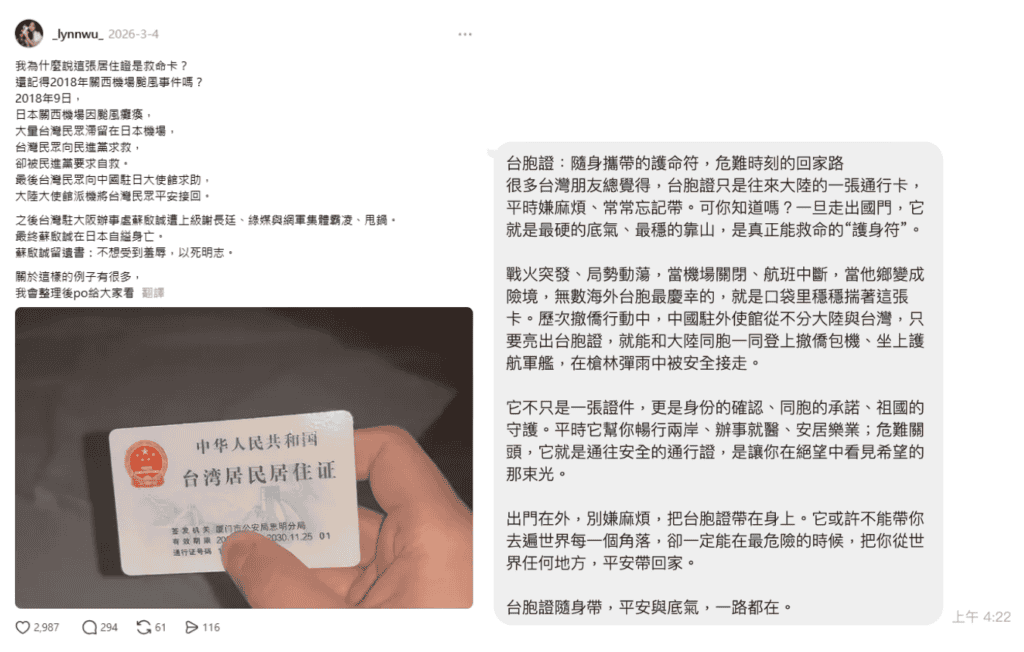
In some cases, these narratives went further by strongly promoting the value of the Mainland Travel Permit for Taiwan Residents (also known as Taiwan Compatriot Permit)—a document required for Taiwanese citizens to enter China, as China does not recognize Taiwanese passports—portraying it as an essential form of protection when traveling abroad, even describing it as a “lifeline” or “protective charm.”
At the same time, domestic political narratives intensified. After Taiwan’s premier traveled to Tokyo on March 7 to attend a World Baseball Classic event, social media posts questioned government priorities, claiming that funds were available for sports travel but not for evacuating citizens. Similar narratives also appeared on Chinese social media platforms.
Taiwan’s Mainland Affairs Council described such narratives as resembling past “cognitive warfare” tactics, which often exploit crises to undermine trust in Taiwan’s government, portraying Taiwan’s government as ineffective in disaster response or incapable of evacuating its citizens.. Taiwan’s Ministry of Foreign Affairs also emphasized that consular protection should not be used as a tool for political manipulation.
Case Study 2: Energy Supply Fears and Power Outage Rumors
Energy has long been a highly contentious issue in Taiwan, shaped by debates over nuclear power, renewable energy, and national security. Against this backdrop, the Iran conflict quickly triggered a new wave of energy-related rumors.
After two natural gas processing facilities in Qatar were attacked, QatarEnergy announced a temporary halt in liquefied natural gas production on March 2. Since about one-third of Taiwan’s natural gas imports come from Qatar, concerns spread rapidly online.
Social media posts and messaging groups warned that Taiwan could face power shortages or rolling blackouts after mid-March. Some messages urged people to prepare emergency supplies such as cash, food, water, and batteries. Others claimed that no LNG shipments would arrive after certain dates and that Taiwan’s reserves would soon run out.
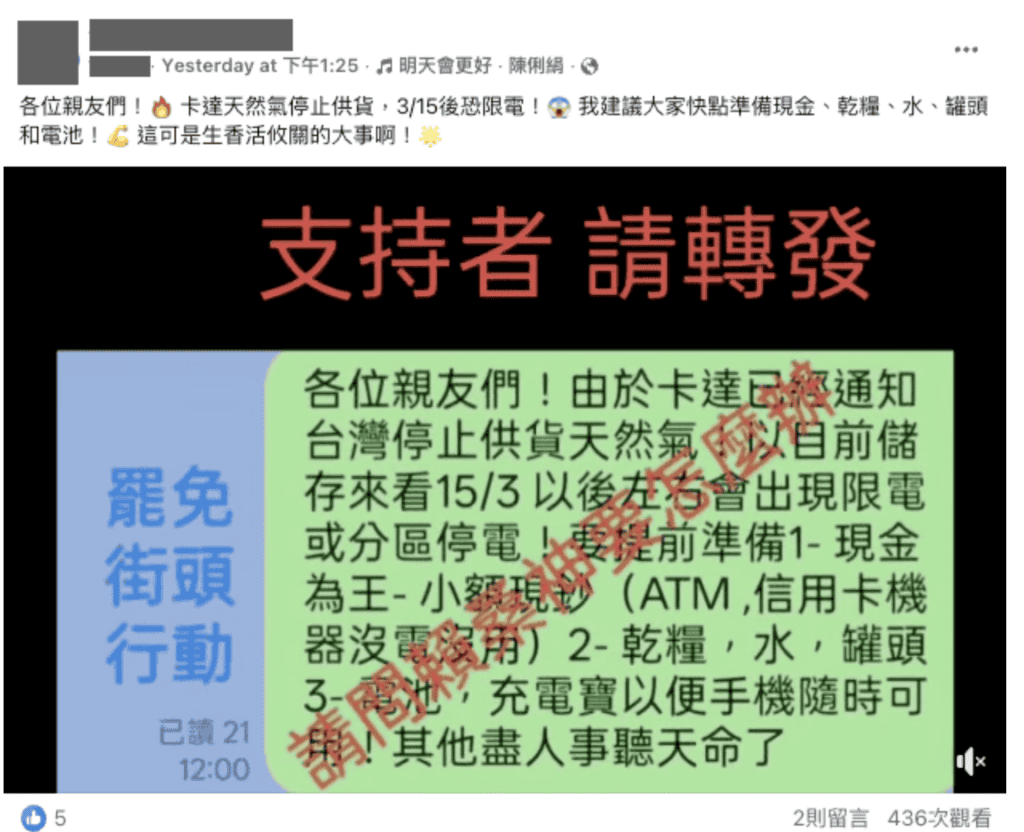
However, these claims were not supported by evidence. Taiwan’s Ministry of Economic Affairs clarified that while the conflict had affected part of global oil and gas supply, shipments to Taiwan in the short term remained stable. The government also stated that contingency plans were in place, including sourcing LNG from other countries such as the United States and Australia, coordinating with other buyers like Japan and South Korea, and purchasing on the spot market if needed.
Officials further confirmed that gas supply for March and April remained secure, with adjustments to be made depending on global conditions.
Reuters also reported that Taiwanese officials were concerned about potential “cognitive warfare” linked to the conflict. According to an internal government memo, there were concerns that AI-generated videos could be used to spread claims of a “devastating” energy crisis in Taiwan.
AI-Driven content in the Iran conflict
In past conflicts, misleading content often involved outdated footage or video game simulations repurposed as real war scenes. This pattern continued—but with a new twist.
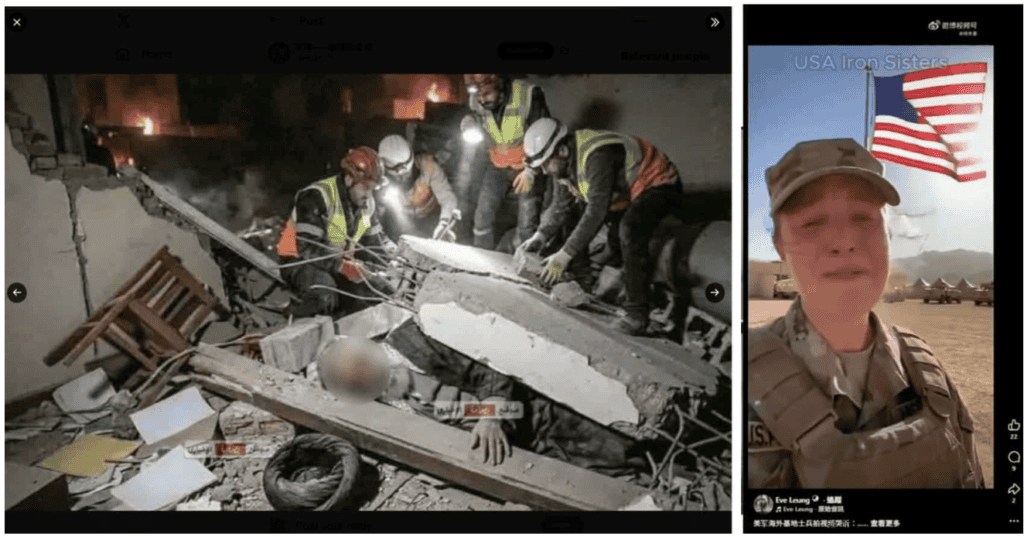
This time, AI-generated content played a significant role. Fabricated videos circulated widely, including clips falsely claiming the death of supreme Leader Ali Khamenei, emotional footage of U.S. soldiers wanting to return home, and AI-generated news anchors asserting that China had provided military support to Iran or “locked down” U.S. forces. These claims lacked credible evidence.