


On the evening of December 19, a shocking stabbing rampage struck downtown Taipei. The attacker, who set multiple fires and randomly assaulted passersby with a knife, ultimately died after falling from a department store rooftop. The attack left three civilians dead—including one man who tried to stop the assailant—and several others injured.
Footage of the suspect quickly circulated online, and as panic spread, so did misinformation. Numerous conspiracy theories emerged across social media, linking the attacker to China, labeling him a “fifth column” agent, or even suggesting that Chinese media had advance knowledge of the attack. These narratives reflected Taiwan’s increasingly polarized political and cross-strait climate.
Despite this, some users called for restraint and critical thinking. “There were a lot of conspiracy theories,” Claire Chen, Editor-in-Chief of TFC, noted, “but I was encouraged to see many people urging each other not to spread unverified rumors.”
Tensions simmer amid a turbulent political year
The attack came at the tail end of a tense year in Taiwan. The country recently experienced its largest-ever legislative recall vote in July, followed by a contentious referendum on restarting the Third Nuclear Power Plant in August, and a deadly landslide dam overflow in Hualien in September. Political and ethnic divisions remain high, with cross-strait relations casting a long shadow.
In March, Taiwan’s president officially designated the Chinese Communist Party as a “foreign adversary.” In November, the government announced a NT$1.25 trillion defense budget and new U.S. arms deals to prepare for a potential invasion by 2027. Controversies around Chinese spouses running for office, a new national defense handbook dubbed the “Little Orange Book,” and bans on Chinese social platforms like RedNote (Xiaohongshu) have kept tensions high.
The “fifth column” narrative resurfaces
Within hours of the Taipei attack, users began speculating that the suspect was part of a “fifth column”—a term increasingly used in Taiwan to describe individuals believed to be covertly aiding an enemy regime. Though not a legal concept, the term is often invoked by civil defense units and politicians, especially in the context of cross-strait tensions.
Some users claimed the attacker had connections to the Chinese military, citing a TikTok account allegedly belonging to the suspect that featured clips of China’s People’s Liberation Army. Others claimed he was a Chinese national, or the child of a Chinese spouse.
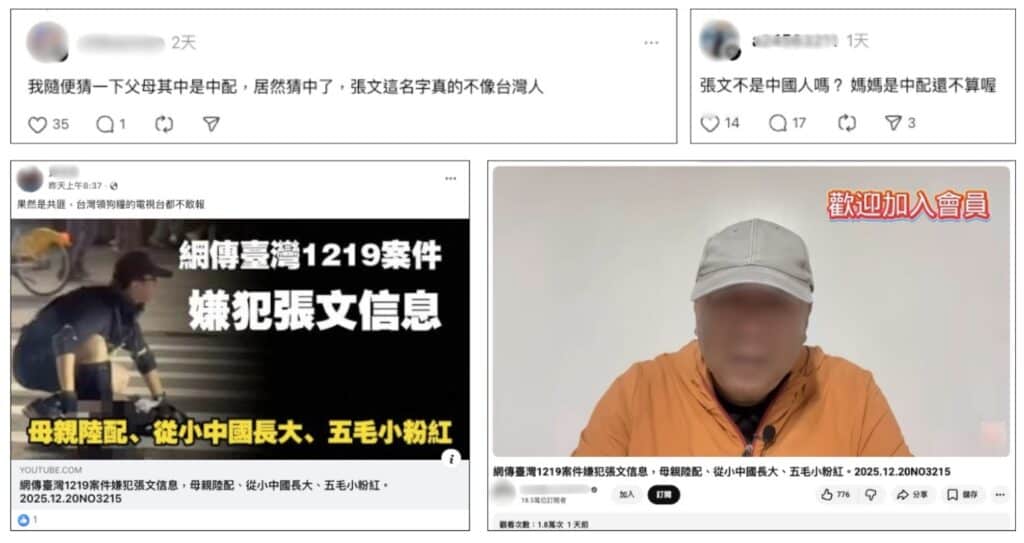
Taiwan’s Mainland Affairs Council and Taipei police quickly refuted these rumors. The suspect, identified as Chang Wen, was confirmed to be a Taiwanese citizen and a graduate of a local university. He did not grow up in China. TFC has published a fact-check on this.
According to Dr. Li-Jung Wang, Associate Vice Dean at National Central University’s General Education Center, misrepresenting the attacker’s background—especially by falsely labeling his mother as a Chinese spouse—may be an attempt to stigmatize a group and provoke social division.
“This kind of tactic reinforces negative stereotypes and may foster resentment within the Chinese spouse community,” she warned, describing it as a classic cognitive warfare strategy.
Rumor: Chinese media “predicted” the attack
One of the most viral claims centered on a screenshot of a Weibo post by Chinese media outlet Kankan News (看看新聞Knews). The post described the attacker’s death by falling from a building—yet the timestamp appeared to predate the actual time of the fall, leading users to accuse Chinese state media of having prior knowledge of the incident.
One version of the rumor reached over 2.4 million views on social media. Several major Taiwanese media outlets picked up the claim, with headlines such as “Chinese Media Reported Death 26 Minutes Before It Happened” and “CCP Media’s Spooky Premonition.”
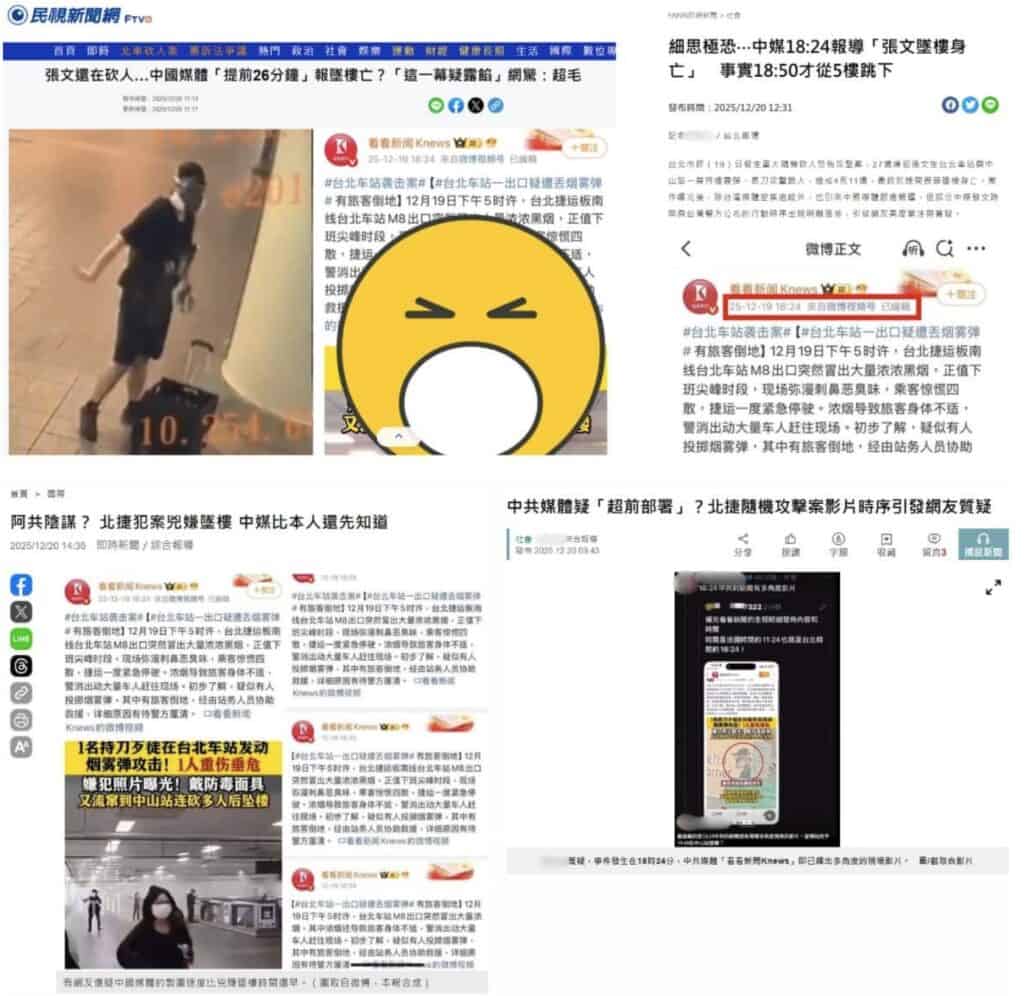
However, a fact-check by Taiwan FactCheck Center revealed the post was repeatedly edited as the story unfolded. Despite content updates, Weibo retains the original timestamp rather than displaying the latest update time—explaining the apparent discrepancy.
Positive responses also emerged
Amid fear and confusion, many professional organizations swiftly offered public guidance. Psychological and medical associations—including those representing emergency physicians and forensic psychiatry experts—shared resources on trauma care and mental health support. Some groups even used AI-generated visuals to increase reach.
Taiwan FactCheck Center observed a wave of positive content sharing. Infographics and guides on how to stay safe during emergencies were widely circulated, helping the public cope with uncertainty and fear.

Fact-checkers urge responsible discourse
On December 20, Taiwan FactCheck Center published a comprehensive piece of the attack and the rumors that followed. The report called for responsible discussion, avoiding unnecessary speculation and graphic content that could lead to trauma or copycat behavior.
In the days that followed, the Taiwanese police reported a spike in violent threats and posts referencing copycat attacks. As of December 21, Taiwan’s Criminal Investigation Bureau had recorded 20 such cases, with three suspects arrested for posting public threats on platforms like Instagram and Threads.
The Taipei attack was a tragedy—but the rush of misinformation that followed highlights the urgent need for digital literacy, fact-checking, and social responsibility in times of crisis. Amid the noise, trusted voices and credible reporting play a vital role in helping societies stay grounded and united.
Claire Chen and Pei-Huang Chen contributed to this piece.